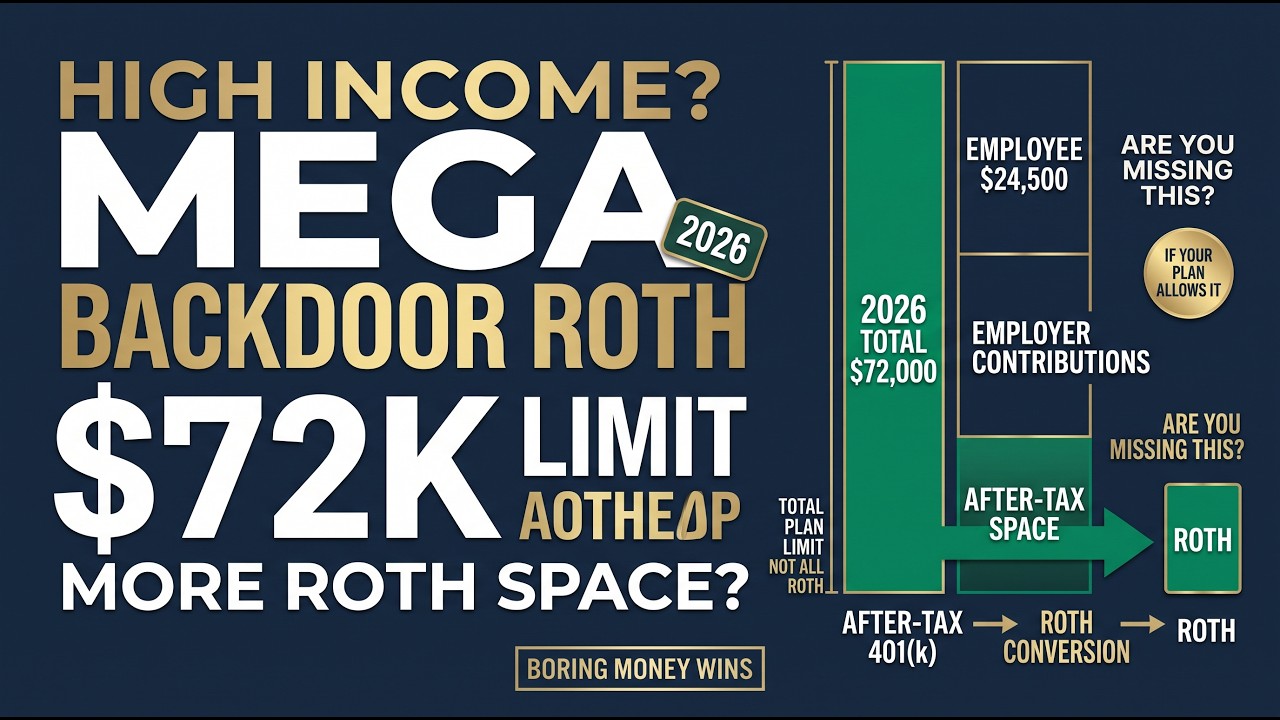
- The 2026 total 401(k) limit is $72,000, covering employee deferrals, employer match, and voluntary after-tax contributions combined.
- The mega backdoor Roth fills the gap between your regular contributions plus employer match and the $72,000 ceiling—with those contributed dollars then moved to the sheltered side.
- Your employer’s 401(k) must allow both after-tax non-Roth contributions AND in-plan conversions or in-service withdrawals—most plans do not.
- The IRS confirmed this strategy is legal in Notice 2014-54, and it remains fully available in 2026.
What Is the Mega Backdoor Roth and Why Does It Matter?
The mega backdoor strategy is not a loophole—it is an IRS-approved method for moving after-tax money into a sheltered account within your 401(k) structure. The IRS codified the rules in Notice 2014-54, which explicitly permits employees to contribute after-tax dollars to a 401(k) and then move those dollars into a designated voluntary sub-account. The strategy has been operating in the open for over a decade, and no legislation has moved to eliminate it. High earners who are already maxing their regular standard deferral can use it to gain access to a substantially larger sheltered bucket than the $24,500 employee limit allows.
The arithmetic is what makes this compelling. In 2026, the overall IRC §415(c) limit—covering all contributions to a defined contribution plan from all sources—is $72,000. If you contribute $24,500 in employee deferrals and your employer adds, say, $12,000 in matching contributions, that leaves $35,500 of headroom under the $72,000 ceiling. Voluntary after-tax contributions can fill some or all of that gap. Once those contributed dollars are in the retirement account, you shift them to the sheltered side—either through an in-plan conversion or by rolling them to an IRA via an in-service withdrawal. From that point forward, the money grows free of ordinary income levies for life. There are no required minimum distributions on these accounts during the owner’s lifetime, and qualified distributions are fully exempt from income tax.
How the Math Works: Calculating Your Mega Backdoor Space
Your available mega backdoor space depends on how much of the $72,000 annual ceiling is consumed by your regular contributions and your employer’s contributions. The formula is simple: $72,000 minus everything else equals your remaining voluntary capacity.
| Contribution Component | Example Amount | Notes |
|---|---|---|
| Employee base deferral | $24,500 | Pre-tax or designated Roth |
| Catch-up (age 50–59, 64+) | $8,000 | Tax-now only if income over $145,000 |
| Employer match (example) | $12,000 | Varies by employer |
| Total contributions so far | $44,500 | |
| 2026 overall limit IRC §415(c) | $72,000 | |
| Voluntary space remaining | $27,500 | $72,000 minus $44,500 |
That $27,500 goes in as after-tax non-Roth contributions, then transfers to the tax-free side through an in-plan conversion or an in-service withdrawal rolled to the IRA.
What Your Plan Must Allow: Two Required Features
The mega backdoor strategy requires two specific plan features that are distinct from ordinary designated 401(k) elections. Many plans offer one but not both, and some offer neither. Before investing any time in this, you must confirm that your specific plan document permits both capabilities.
| Feature | What It Means | How Common? |
|---|---|---|
| After-tax non-Roth contributions | The ability to contribute dollars beyond your elective deferral limit into a separate voluntary bucket within the 401(k)—distinct from the designated after-tax sub-account | Minority of plans; more common at large employers |
| In-plan conversion | The ability to shift voluntary non-Roth balances to the sheltered side within the same plan without leaving the employer | Less common than voluntary contributions; often added separately |
| In-service withdrawal | The ability to roll voluntary non-Roth balances to a sheltered IRA while still employed; an alternative when in-plan conversion is unavailable | Uncommon; the retirement account must explicitly permit distributions while employed |
How to Find Out If Your Plan Qualifies
- Download the Summary Plan Description (SPD) and search the document for the phrase “after-tax contributions.” The SPD is a plain-language summary of the retirement account rules available from your HR department or benefits administrator’s website. If “after-tax contributions” does not appear, the account likely does not permit them.
- Call your benefits administrator and ask two specific questions: (1) “Does my 401(k) allow after-tax non-Roth contributions beyond the elective deferral limit?” and (2) “Does it allow in-plan conversions or in-service withdrawals of voluntary amounts while I am still employed?” Both must be answered yes for the full strategy to work.
- When rolling over, request a direct rollover—never a cash distribution. If the employer sends you a check, it is required to withhold 20% for federal withholding, even on after-tax dollars. You then have 60 days to roll the full amount—including the withheld 20% from other funds—to the sheltered IRA, or the payout is treated as ordinary income.
In-Plan Conversion vs. Rollover to Roth IRA
| Factor | In-Plan Conversion | In-Service Rollover to Roth IRA |
|---|---|---|
| Where money lands | Stays inside the 401(k) as a designated after-tax balance | Moves to the IRA outside the employer’s account |
| Requires leaving employer | No | No, if the account allows in-service withdrawals |
| Withholding risk | None—stays in the 401(k) | Risk of 20% withholding if not direct rollover |
| Roth IRA income limits apply | No | No—rollovers are not subject to IRA contribution income limits |
| Investment control | Limited to the 401(k) investment menu | Unlimited—any investment available in your Roth IRA |
| Access before 59½ | Subject to the account’s distribution rules | IRA contribution basis is accessible anytime; earnings have 5-year + age rules |
High earners above $161,000 (single) or $240,000 (married filing jointly) cannot make direct contributions to a sheltered IRA due to income limits. Rolling over voluntary after-tax 401(k) amounts to the IRA sidesteps this restriction entirely. Notice 2014-54 explicitly confirms that when a 401(k) distributes a mix of after-tax and pre-tax amounts, the employee can direct the contributed portion to the sheltered IRA and the pre-tax portion to a traditional IRA—the two do not have to go to the same destination.
Tax Consequences and the Convert-Early Rule
Voluntary after-tax non-Roth contributions have already been taxed as ordinary income, so you do not owe additional levy on the principal when you shift it. You owe ordinary income charges only on any earnings that accumulated in the voluntary bucket before the transfer. If you contribute $5,000 in January and move it in March, the amount owed might be $20 in interest—essentially negligible. The problem grows when you let these contributed dollars sit for months or years: the compounding gains turn a clean move into a meaningful bill.
The pro-rata rule—which applies when you roll a traditional IRA to a sheltered account and have pre-tax IRA balances elsewhere—does not apply here. Notice 2014-54 clarified that a direct rollover of voluntary 401(k) amounts to the sheltered IRA is treated as coming entirely from contributed dollars. You are not forced to blend pre-tax and contributed portions in proportion. This is a significant distinction from the ordinary backdoor IRA strategy, which can be complicated by existing IRA balances.
Record-Keeping: Non-Negotiable
You must track your voluntary after-tax cost basis separately from all other 401(k) balances. Your benefits administrator tracks this internally, but you should verify it annually against your year-end account statement. If you roll these amounts to the IRA, you must file Form 8606 with your federal return to report the nontaxable portion of the rollover. Failure to file Form 8606 can result in double-counting at distribution. Keep records indefinitely—IRS statute of limitations does not protect you if you cannot prove the basis.
The Roth Five-Year Clock for Conversions
Each in-plan transfer starts its own five-year holding period. This matters for earnings access before age 59½: if you withdraw earnings from a transferred amount before both five years have passed and you have reached 59½, you may owe ordinary income levies and a 10% penalty on those earnings. Contributions you made directly—not transfers—are always accessible penalty-free at any time, because you already paid the levy on them. The five-year rule applies only to earnings.
The practical solution is to open the sheltered IRA as early as possible, even if you fund it with a small amount—$1 qualifies. The five-year clock starts on January 1 of the year for which you make the first contribution. An account opened and funded in 2026 starts its clock on January 1, 2026. If you roll mega backdoor funds into that account in 2030, the earnings clock is already four years old. This small early action can save years of waiting.
Before You Start: 5 Things to Verify
- Your employer’s 401(k) allows after-tax non-Roth contributions. Download the Summary Plan Description or call your benefits administrator and ask explicitly. This is the first gate — the strategy does not exist if this feature is absent.
- In-plan conversion or in-service withdrawal is available. Without one of these, voluntary contributions sit accumulating taxable earnings until you separate from your employer. Both questions must be answered yes for the full strategy to work while employed.
- Your voluntary contribution space is calculated correctly. The formula is $72,000 minus your planned employee deferral (including any catch-up) minus your estimated employer match. Update this each year as employer contributions change.
- You have a sheltered IRA open and funded, even minimally. Opening the account early starts the five-year clock on January 1 of that year. Rolling mega backdoor funds into an established IRA that is already years old avoids waiting on the earnings clock entirely.
- You have a transfer and record-keeping plan in place. Move funds quarterly to minimize taxable gains sitting in the voluntary bucket. File Form 8606 every year you complete a rollover. Keep basis records indefinitely — the IRS has no statute of limitations if you cannot prove basis at distribution.
Bottom line: The mega backdoor strategy delivers the most value to high earners who are already maxing their standard 401(k) deferral, whose employer specifically supports both required features, and who are willing to manage quarterly fund movements and annual Form 8606 filings. It is not a passive set-and-forget approach — it requires annual attention to payroll elections, transfer timing, and basis tracking. For eligible participants who are disciplined about execution, it opens a sheltered savings pathway that is many times larger than the standard IRA limit allows.